Pioneering works from Random International, teamLab, A.A.Murakami, Simon Heijdens, and Es Devlin delve into the intersection of artistic expression, technological innovation, and the natural environment
MUMBAI, INDIA, September 16, 2026 /EINPresswire.com/ — The Nita Mukesh Ambani Cultural Centre (NMACC) is proud to announce Second Nature, a pioneering immersive exhibition that sheds light on the dynamic and interdependent connection between humanity, technology, and the natural environment. This global initiative unites an international roster of artists who are at the cutting edge of art and technology, and is curated by the co-founder and the curator of the innovative experiential art platform Superblue. Occupying all four levels of the Art House, the showcase features expansive installations from Random International, teamLab, A.A.Murakami, Simon Heijdens, and Es Devlin, each of which engages interactively with the space and its visitors, marking their debut presentation in India. The exhibition is open to the public now and will run until January 10, 2027.
“In the current era, art is moving past conventional boundaries, influenced not just by human creativity but also by intelligent systems that are learning to understand our surroundings. With Second Nature, we aimed to deliver an experience for the nation that evokes curiosity, emotion, and introspection, exploring the growing fusion of technology, nature, and human inventiveness,” said Ms. Isha Ambani. “This exhibition welcomes visitors to engage in a conversation with a future that already feels remarkably tangible.”
Organized by Mollie Dent-Brocklehurst, co-founder of Superblue, and Margot Mottaz, head of curatorial, Second Nature converts digital systems into interactive environments that encourage physical engagement rather than passive viewing. Through the artists’ inventive approaches, familiar and sometimes disconcerting technologies that increasingly influence our daily lives are transformed into sensory, evocative, and poetic experiences, capturing the tension between control and release, whether yielding to digital algorithms or the natural processes of decay and renewal. Moving beyond flat screens or traditional canvases, these immersive works motivate visitors to move, react, touch, and integrate themselves into the artwork. Second Nature delves into the dissolving boundaries between humanity, nature, and technology, drawing visitors into the lively ecosystems that are shaping our collective future.
This exhibition aligns with NMACC’s mission—to bring global excellence to India and Indian excellence to the world. Earlier exhibitions at the Art House have featured works by renowned artists like Doug Aitken, Maurizio Cattelan, Pierpaolo Ferrari, and the Dia Art Foundation. The National Pavilion of India at the 61st International Art Exhibition—La Biennale di Venezia, organized by the Ministry of Culture, Government of India, in collaboration with NMACC and Serendipity Arts, further highlights the Centre’s commitment to presenting India’s artistic legacy on an international stage.
“We are thrilled to introduce some of the most influential artists in experiential art to India for the first time through the Nita Mukesh Ambani Cultural Centre, allowing new audiences to discover their complex, interactive installations. The pieces in Second Nature demonstrate how technology can amaze, inspire, and delight, while also prompting us to consider its significant impact on our daily lives,” added Dent-Brocklehurst and Mottaz.
ABOUT THE INSTALLATIONS
Floor One: Random International
The three installations by the London-based collective Random International delve into the psychological intricacies of the digital gaze, addressing themes of identity, memory, and our instinctive emotional connections to our own reflections. By transforming automated technologies into interactive mirrors, these works blur the lines between human and machine, observer and art, making the viewer the central focus. Central to this is Presence and Erasure (2019), a “portrait machine” that captures and briefly prints large-scale images of visitors, only for them to fade away within minutes: a fleeting, one-of-a-kind experience reflecting on the impermanence of our existence.
Also on display is Our Future Selves (2019), where viewers encounter their three-dimensional reflections represented as points of light. This experience is both familiar and dreamlike, occupying an ambiguous psychological space between a live mirror image and a static picture. Additionally, Audience (2008) showcases a collection of anthropomorphic, mechanical mirrors. When a visitor approaches, these mirrors shift from their independent movements to follow the visitor in a unified, curious manner. Confronted by their own image from all sides, the visitor experiences a profound, heightened awareness, moving from a passive observer to an active participant in a dynamic, shared environment.
Floor Two: teamLab
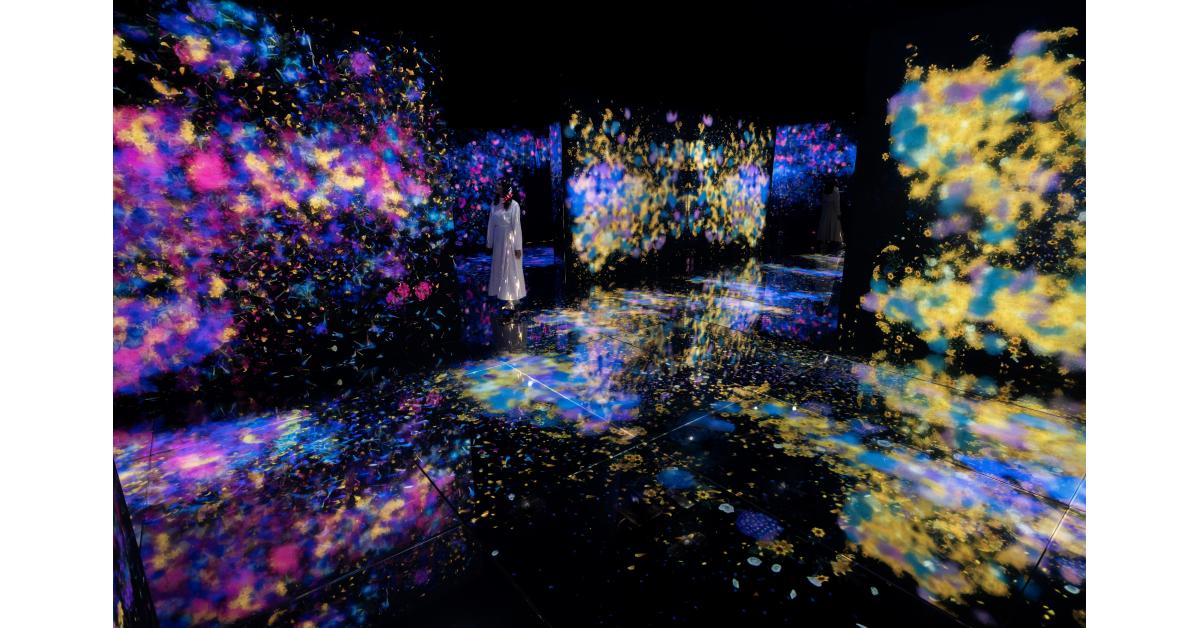
The three installations by the Tokyo-based international art collective teamLab investigate the coexistence between humans and their surroundings through dynamic, ever-changing digital environments shaped by human interaction. Rather than viewing humanity and nature as opposing forces, these interactive pieces explore a thriving ecosystem that includes people, encouraging visitors to move beyond being passive spectators and engage actively in a shared, living space. One of teamLab’s signature interactive spaces, Flowers and People, Cannot be Controlled but Live Together (2014—ongoing), creates a real-time floral ecosystem that blooms and withers in response to human presence. Since no two moments are ever the same, each visual is ephemeral, offering a meditation on a relationship with nature that is perpetually changing.
Resonating Microcosms — Solidified Light (2022—ongoing) brings teamLab’s exploration of interactive light into the physical realm, featuring a captivating collection of glowing, multicolored ovoid sculptures that illuminate and produce sound when touched, creating an immersive environment where the visitor becomes an essential component. The NMACC presentation introduces new hanging light features that enhance the work’s vibrant color palette, subjectivity, and visual depth. Finishing this floor is Nirvana (2013), a reimagining of an 18th-century Japanese painting by Ito Jakuchu. Constructed in a virtual 3D space and transformed into teamLab’s signature “ultrasubjective space,” the artwork distributes color across tens of thousands of screen segments to overcome the constraints of fixed perspective. For the NMACC display, the piece will be rendered on a dazzling wall of rhinestones that scatter and refract light, creating a mesmerizing visual effect where two distinct viewpoints coexist: from a distance, vibrant plants and animals move slowly, while up close, the pixelated colors shift rapidly, blurring the lines between traditional static art and abstract pixelation while echoing nature’s continuous cycle.
Floor Three: Simon Heijdens and A.A.Murakami
The two installations by Simon Heijdens and A.A.Murakami encourage visitors to contemplate an emerging future where technology moves beyond screens to become tangible, adopting the rhythms and impermanence of the natural world. These works introduce elements of unpredictable organic randomness into the pristine gallery setting, requiring the presence of the audience and external weather conditions to come to life. Heijdens’ Lightweeds (2005—ongoing) brings a fluctuating natural rhythm into the built environment through an ecosystem of plants that live, move, and grow in response to real-time data from weather sensors installed outside. This piece is in constant flux, adapting to local weather conditions and the movement of people, revealing the area’s natural essence. A.A.Murakami’s New Spring (2017—ongoing) is an interactive tree-like sculpture that emits mist-filled blossoms. These delicate “bubbles” pop upon contact with skin, turning the ephemeral beauty of spring into a tangible, shared moment that evokes a deep emotional and psychological awareness of nature’s fragility and transience.
Floor Four: Es Devlin
The exhibition reaches its peak on the fourth floor with Screenshare (2025), a major piece by British artist Es Devlin, presented in a new version created specifically for NMACC. The installation showcases a monumental screen constructed from 365 physical sketchbooks that contain traces, drawings, and processes capturing the artist’s thoughts over the past quarter-century. Against this archival backdrop, a short film features dancer Dam Van Huynh, who has been re-filmed performing alongside a recording of his younger self from nearly twenty years earlier for Devlin’s original piece: a meditative reflection on how the body marks change as we navigate life. Screenshare dissolves the boundary between observer and artwork in its finale: at the end of the film, viewers are invited to step forward and take a page from the screen home with them. This interactive act permanently disrupts the physical structure of the piece, turning an intimate personal archive into a shared, distributed narrative.
ABOUT THE NITA MUKESH AMBANI CULTURAL CENTRE
The Nita Mukesh Ambani Cultural Centre (NMACC) is a pioneering, multidisciplinary arts venue located in the heart of Mumbai, India. Since its opening in March 2023, it has become a significant cultural hub, uniting the finest of Indian and international live performance, visual art, and craft on a world-class platform, with culture at the core of every experience.
The Centre features three vibrant performing arts spaces – the grand 2,000-seat Grand Theatre, the high-tech 198-seat Studio Theatre, and the intimate 80-seat Cube – in addition to the four-story Art House, a dedicated visual arts space showcasing exhibitions and immersive installations by leading Indian and international artists and curators. Throughout its concourses, NMACC presents an impressive collection of public art by renowned Indian and global artists, along with Swadesh by Reliance Foundation, an evolving exhibition celebrating India’s rich artisanal heritage.
In just three years, the Cultural Centre has made a significant impact, hosting an outstanding range of visual arts exhibitions including POP: FAME, LOVE AND POWER by Lawrence Van Hagen, Run As Sure As You Can by TOILETPAPER, two successful editions of Bhakti, UNDER THE SUN by Doug Aitken, and most recently A Fistful of Sky by Subodh Gupta, among others.
Complementing its artistic offerings are curated culinary experiences at NMACC Arts Cafe, NMACC Theatre Cafe, and The Bar.
Recognized globally, NMACC is the first Indian arts institution to be honored by the prestigious Japanese publication Madame Figaro as one of the world’s seven leading cultural destinations.
The National Pavilion of India at the 61st International Art Exhibition – La Biennale di Venezia – Geographies of Distance: remembering home – presented by the Ministry of Culture, Government of India, in partnership with NMACC and Serendipity Arts, and curated by Dr. Amin Jaffer, further underscores the Centre’s expanding cultural influence.
###
Shreya Labh
Resnicow and Associates
+1 212-671-5163
nmacc@resnicow.com