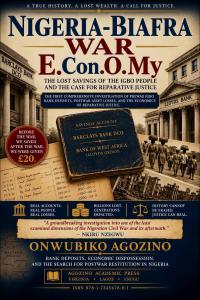
Criminologist Onwubiko Agozino examines lost savings, legal barriers, and accountability through a human-rights intervention from Eastern Nigeria’s postwar era.
Decades after the guns fell silent in the Nigeria-Biafra conflict, a lingering and painful question remains unresolved: what became of the savings, investments, and accumulated wealth of people in Nigeria’s former Eastern Region? Criminologist Onwubiko Agozino tackles that enduring mystery head-on in his new work, Nigeria-Biafra War E.Con.O.My: Reparative Justice for Stolen Wealth and the Case for National Atonement. The book shines a light on losses that have haunted families—particularly those of Igbo descent—for more than half a century, arguing that the consequences of these confiscations demand far more than a nod to history.
Agozino’s stake in this story is both scholarly and deeply personal. He recounts how his own father lost his life savings to the government and international banks, a blow that forced the family to sell land just to cover his high school fees. That lived experience grounds the issue in stark, tangible terms: money set aside before the war could no longer meet the needs that continued long after it ended.
The scope of the account widens to include traders who never rebuilt their businesses, civil servants whose retirement funds simply vanished, and churches, cooperatives, and community organizations left with unfinished development projects. Carried across generations through family memories, testimony, and community narratives, these experiences represent more than individual bank balances. They tie the loss of private wealth to interrupted livelihoods and collective ambitions, giving the reparations argument a reach that spans households and institutions alike.
A quantitative layer adds weight to the appeal, considering compound interest on estimated savings at variable rates. For readers focused on the economic underpinnings of reparative claims, this approach offers a way to reckon with losses over time, rather than fixating solely on the original sums withheld. The math sits alongside a legal hurdle: Agozino identifies an ouster clause in a military decree that, he contends, barred Nigerian courts from hearing challenges to the confiscation of savings and abandoned properties.
Agozino also highlights the ECOWAS Court of Justice as a potential venue for human-rights issues, even as he insists that redress need not hinge on litigation. His proposed path calls for the government to recognize the decree’s nullity and pay reparations to affected citizens as a legal obligation. He argues that such a move could prompt banks to follow suit without admitting wrongdoing. These are proposals for accountability, not claims of reparations already achieved.
Framed as a policy intervention in support of human rights rather than an academic textbook, the book draws on theories of Black Reconstruction in America, reparative justice, and racial capitalism. Its blend of economic calculation, legal constraints, and historical memory offers distinct entry points for historians, sociologists, economists, criminologists, legal and policy scholars, human-rights activists, policymakers, and general readers grappling with the fallout of postwar dispossession.
“This book documents the history, evidence, estimates of lost values and compound interests, and presents the case for reparative justice.”
— ONWUBIKO AGOZINO
Onwubiko Agozino is a criminologist and a childhood survivor of the 1967-1970 war in Biafra. His work on postwar reparative claims brings professional rigor to a history he experienced firsthand as a child.
Available now. Get your copy here:
https://www.amazon.com/dp/B0HK2GC7CV
For review copies, interview requests, or additional information, please contact:
Onwubiko Agozino
BrightKey PR
media@brightkeypr.com
Why it matters: This book reframes a half-century-old grievance as a live legal and moral claim, pressing Nigeria to confront the enduring economic wounds of the Biafra war. By pairing personal testimony with legal analysis, Agozino’s work offers a blueprint for how nations might begin to atone for state-sanctioned wealth seizures—an issue with resonance far beyond West Africa.