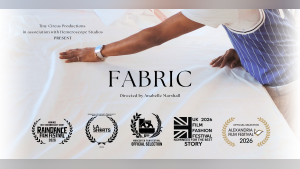
The festival circuit for FABRIC, the short documentary that puts a human face on refugee artisans breaking into French haute couture, is expanding. Fresh off special preview events in New York and Washington, D.C., the film has locked in its next two official premieres: the FABRIC team will bring it to the Alexandria Film Festival in Virginia on November 13th and the UK Fashion Film Festival in London on November 20th.
At the UK Fashion Film Festival, the documentary has already earned a nomination for Best Story. These upcoming dates follow last week’s special preview screenings at Atelier Jolie in New York City and the Alliance Française de Washington D.C., where the film was introduced by the creative team to an audience drawn from the intersections of cinema, fashion, activism, and social enterprise.
Directed by award-winning documentary filmmaker Anabelle Marshall, FABRIC takes audiences inside Espero Atelier, a Paris-based social enterprise that trains refugees in tailoring and helps them find footholds in the fashion industry. The film traces the artisans as they create a one-of-a-kind collection destined for the Musée d’Orsay, timed to the eve of Haute Couture Week.
Also worth a look: Aiarty unlocks cross-platform lifetime licenses for Black Friday with new AI video tool update and Portfolio DAM 4.2 gives media owners AI-ready search without giving up data control.
The project has already collected notable hardware: it won the Immaculate Heart Community Social Impact Award at the LA Shorts International Film Festival and was nominated for Best Documentary Short at the 34th Raindance Film Festival, the UK’s largest independent film festival.
At the center of the story is Maya Persaud, co-founder of Espero Atelier. A former fashion model with deep roots in luxury fashion, Persaud grew up across San Francisco, Washington D.C., and Hawaii, and has called Paris home for decades. Her organization creates opportunities for refugees and marginalized communities through fashion education, skills training, and employment.
The documentary follows Espero team members Ibrahim, Suad, Haider, Sumaiya, and Cynthia—who hail from Guinea, Eritrea, Afghanistan, and Congo respectively. The film tracks their personal and professional growth in the lead-up to the landmark runway show, revealing how the program has helped them integrate into French society.
Alongside Persaud and the Espero artisans, the film features voices from the worlds of fashion and culture, including Catherine Brickhill, a former Alexander McQueen and Givenchy designer who now mentors at Espero, and Sylvain Amic, who served as President of the Musée d’Orsay and Musée de l’Orangerie at the time of filming.
“Inspired by the incredible work of Paris-based non-profit fashion collective Espero and in light of current events in the world, Fabric humanizes the refugee experience and shifts the prevailing narrative,” said director Anabelle Marshall. “Revealing how the lives of displaced people have been woven together by resilience and a shared humanity, using their skills to build a creative community. We are delighted with our recent special preview screenings in the US and honored with the official selections of FABRIC by the Alexandria Film Festival and the UK Fashion Film Festival.”
Espero founder Maya Persaud added: “The refugees that I work with have been through significantly challenging experiences and have come out the other side to rebuild their lives in such an awe-inspiring way. I am delighted to bring their stories to audiences with FABRIC and showcase their hard work and exceptional skills within the fashion industry.”
Produced by Tiny Circus Productions and Hemeroscope Studios, FABRIC is a UK-France co-production led by a global majority female filmmaking team committed to telling stories that foster empathy and deepen cross-cultural understanding.
For press queries: sanam@tinycircusproductions.com
Sanam Chida
Tiny Circus Productions
+44 7837 441248
Fabric Trailer
Why it matters: In an era when refugee narratives are often reduced to statistics, FABRIC offers a counterpoint by centering craft, dignity, and integration through fashion. Its expanding festival footprint signals growing appetite for stories that reframe displacement around skill and belonging rather than victimhood.