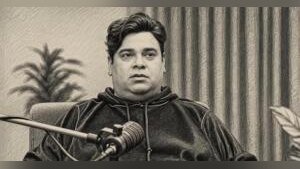
The debate over artificial intelligence replacing human talent is no longer theoretical — it’s personal. In a revealing new episode of the interview series Tomorrow, Today, actor and comedian Kiku Sharda lays out why, after a quarter-century in the entertainment business, he would still choose a performance by real actors over one generated entirely by AI.
The episode, hosted by Shekhar Natarajan and released November 20, 2026, features Sharda reflecting on his unconventional path from an MBA graduate in a Mumbai business family to one of India’s most recognizable television faces. He describes himself as an introvert who grew up in Bandra and completed an MBA — as his father insisted for all three sons — before running a small events company while performing theater. At 19, he joined a professional play that toured Dubai, London and Hong Kong. His first television role came in 2003, playing Hobo on the Star Plus series Hatim, a job he says convinced both his family and himself that acting could be a real career.
In the conversation, Sharda walks through how he builds his most famous comic characters, including Palak, Bachcha Yadav and Achcha Yadav. He explains that the transformation starts with the costume. “Once I see myself in the mirror dressed up as someone else, then the character takes over,” he said. He and the show’s writers also construct a detailed back story for each persona, so the audience believes the person is real. On improvising with Kapil Sharma, he noted the show keeps rolling when something unscripted happens — a mark of trust between the performers and the crew.
Also worth a look: Prime 1 Studio opens pre-orders for a $799 Compsognathus diorama from The Lost World and Filippo Loreti crafts two exclusive Lord of the Rings automatic watches, each limited to 100.
The discussion also ventures into the technical craft of acting across different formats. Sharda draws distinctions between theater, television and film, emphasizing the precision required for camera work. But the most pointed segment of the interview addresses deepfakes and consent. Sharda reveals that he received an offer to let a film use his face and voice without his physically taking part in the shoot — a proposal he clearly found troubling.
When asked directly, Sharda said that if a theater offered several films made entirely with AI alongside one made with real actors, he would probably choose the one with real actors. He added that he wants any viral success to come from his own work, not from content created without his consent. “I don’t call myself a comedian. I call myself an actor. So I want to do everything that comes under the basket of being an actor,” he said.
The episode includes a live experiment: Natarajan asked an AI system to suggest Sharda’s next comic character. Sharda, however, expressed a wish to take on serious and even dark roles — a sign he is looking to stretch beyond comedy after roughly 25 years in the industry.
“This is a classic example of AI being a support system versus AI which is replacing humans,” said Natarajan. “That should be the journey of AI systems, that they don’t replace us, because we are humans and we have something deep which makes us human.”
The full episode is available on YouTube at this link.
Why it matters: As AI-generated content becomes more convincing and commercially viable, the entertainment industry faces a fundamental choice about what audiences value. Sharda’s stance — grounded in decades of live and on-camera performance — signals that even seasoned professionals see a line between using AI as a tool and letting it replace the human element entirely. For viewers, the question is whether that human element still matters more than convenience or novelty.