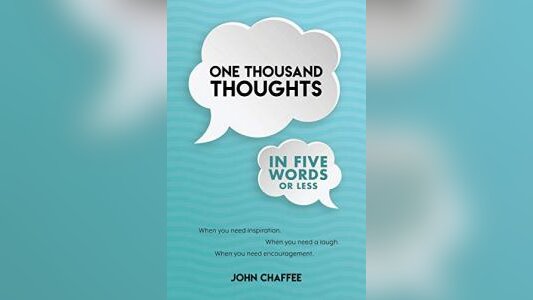
In an age of endless scrolling and verbose commentary, one author is betting that the most powerful messages fit in a handful of syllables. John Chaffee’s One Thousand Thoughts in Five Words or Less dares to ask what happens when every line must earn its place in five words or fewer. The result is a collection that proves brevity isn’t just wit’s soul—it’s also a playground for love, humor, and even civic pride.
A declaration of love, a playful observation, and a heartfelt thought can all fit within the same small space. In One Thousand Thoughts in Five Words or Less, John Chaffee gathers 1,000 thoughts under a single constraint: none exceeds five words. The collection brings whimsy, reflection, and nonsense together without asking brevity to serve just one mood or subject.
The format emerged from the writing rather than from a rule set in advance. Chaffee describes waking one morning with an unexplained phrase in his head and writing it down. Other thoughts followed. Only after recording about twenty did he notice that each contained five words or fewer. He continued until that unexpected pattern had become a collection of one thousand entries.
Also worth a look: Filippo Loreti’s Lord of the Rings watches pit Saruman against Sauron for $485 each and In a new romantasy, two heirs must overcome 500 years of hatred to break an ancient curse.
Chaffee’s description emphasizes the breadth of expression possible within that limit. Some thoughts are profound, others heartfelt, and still others are pure nonsense. He also allows for the possibility that certain entries may stir deep emotion. These are not presented as uniformly serious observations or as a collection devoted only to jokes; the stated range leaves room for both feeling and absurdity.
The examples Chaffee offers make that contrast concrete. They encompass a promise of lasting love, language about national unity, and a joke that gives cement a hard life. Affection, civic sentiment, and an everyday material each become subjects for the same concise form. The shared word limit connects expressions that otherwise have little in common, illustrating the variety behind the book’s numerical premise.
Another point of connection is ordinary speech. Chaffee notes that readers may already have said some of these brief expressions themselves, perhaps more than once, without counting their words. That observation places the collection’s constraint within familiar experience rather than treating economy of language as something reserved for writers. The book draws attention to how compact everyday expressions can be, even when their speakers have no particular word limit in mind.
Blank pages at the end extend the premise into a reader contribution. Chaffee leaves room for additional thoughts, with the same five-word maximum applying to those additions. Readers can use that space to record their own expressions rather than simply finish at entry one thousand. The invitation gives the volume a practical element for anyone interested in trying a tightly bounded writing exercise.
For readers drawn to brief observations, verbal humor, or concise expressions of feeling, the collection offers those interests within one consistent format. Its invitation is specific: consider what a few words can express, then try contributing a thought of one’s own.
Mr. John C. Chaffee Jr. is the author of One Thousand Thoughts in Five Words or Less. His collection grew from a practice of recording short thoughts. Available now.
Get your copy here:
https://www.amazon.com/dp/1986271544
For review copies, interview requests, or additional information, please contact:
Mr John C Chaffee Jr
BrightKey PR
media@brightkeypr.com
Why it matters: In a media landscape that rewards volume, Chaffee’s book is a quiet counterargument that constraint can unlock creativity. It reminds us that some of the most resonant thoughts—whether profound or playful—need only a few words to land. And by inviting readers to write their own, it turns a finished collection into a living exercise in the power of limits.