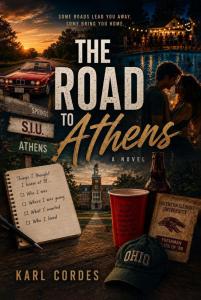
Karl Cordes captures the essence of American college life in 1988 through a story of love, friendship, belief, accountability, pardon, and fresh starts.
In The Road to Athens, author Karl Cordes examines the challenging shift from youth to maturity within a romantic coming-of-age drama set on an American college campus in 1988.
The narrative centers on eighteen-year-old Ethan Brooks, who departs from suburban Chicago heading to Southern Illinois University, fully believing that college will be the ultimate adventure. He anticipates independence, camaraderie, celebrations, love, and the chance to reshape his identity away from familial pressures. However, a single impulsive choice triggers unavoidable repercussions, compelling him to face remorse, emotional pain, loss, and the dawning understanding that becoming an adult involves more than just leaving childhood behind.
When Ethan’s once-familiar life begins to crumble, he encounters Jessica McCormick. Intelligent, emotionally intuitive, and raised in a sphere of affluence, power, and complex demands, Jessica evolves into far more than a romantic partner. Their unforeseen bond serves as the story’s emotional core, pushing both individuals to embrace honesty, accountability, and dedication when circumstances offer them every excuse to turn away.
Ethan’s path eventually leads from Southern Illinois University toward an unforeseen chance at Ohio University. The literal journey to Athens mirrors his internal shift from shame, dread, and doubt toward responsibility, clemency, belief, and optimism. Athens symbolizes more than just a destination. It stands for the chance to rebuild after the recognizable parts of a life have shattered—and the chance to become a person defined by accountability rather than forever marked by a single error.
Set in an era before mobile phones, social networks, GPS, and instant access to others’ lives, The Road to Athens evokes the unique atmosphere of the late 1980s. Friendships developed in person. Long-distance calls carried significant weight. Gossip traveled through people rather than screens, and relationships depended on conversation, trust, patience, and physical presence. Music, automobiles, dorm rooms, packed bars, icy roads, and collegiate customs do more than provide nostalgic decoration; they shape the emotional landscape where Ethan and his friends discover that liberty and consequence frequently arrive together.
Within that setting, the book explores first love, lasting friendship, familial devotion, temptation, race, social class, privilege, violence, and institutional accountability. Its characters inhabit a world that can be humorous, romantic, reckless, frightening, and profoundly touching—sometimes all within the same evening.
While nostalgia lends the story warmth and immediacy, Cordes does not use the past to evade consequences. Instead, he questions what the experiences people remember most fondly may also have asked of them.
“I wrote The Road to Athens for anyone who has ever wondered if one painful choice forever shaped the rest of their life,” Cordes said. “Ethan cannot change what occurred, and he cannot manage every outcome. What he can do is take responsibility, accept forgiveness, and decide what kind of person he will become.”
Two chapters are especially significant to the novel’s message. In “He Never Left,” Ethan confronts his guilt, shortcomings, fears, and uncertainty while understanding that accepting responsibility does not mean believing he controls every event or result. Later, “The Wilderness Is Not Your Destination” presents hardship as a temporary phase rather than a permanent identity.
“The wilderness may be part of a person’s journey, but it does not have to become the destination,” Cordes said. “Failure can be a place where transformation begins rather than the place where someone’s story ends.”
The book is aimed at readers carrying regret or questioning whether a difficult choice has permanently set their future. Its themes may also resonate with young adults navigating identity and relationships, parents seeking insight into the pressures surrounding emerging adulthood, readers nostalgic for the music and culture of the late 1980s, and people of faith enduring challenging seasons.
At its core, The Road to Athens is a story of redemption. Ethan starts his journey in search of liberty and discovers that genuine freedom cannot be separated from accountability. He experiences friendship, love, temptation, fear, and loss before realizing that moving forward does not require denying the past. It requires confronting it honestly and refusing to let it become his permanent identity.
Through Ethan’s story, Cordes preserves the exhilarating uncertainty of being eighteen in another era while exploring experiences that remain timeless. The novel’s enduring message is that a person’s worst decision need not become a final definition, difficult seasons do not have to become permanent destinations, and even an unexpected road can lead toward healing, hope, and home.
Karl Cordes is an American author whose fiction explores the uncertain passage from adolescence into adulthood. His professional life began in radio broadcasting and later continued in technology and enterprise software sales. Drawing upon his Midwestern perspective, experience in communication, and enduring interest in music, place, and memory, Cordes writes character-driven fiction about love, accountability, reinvention, and human connection. The Road to Athens is his debut novel.
The Road to Athens was published by Visionary Book Publishers and is now available in print and digital editions.
The book is available at:
https://a.co/d/02ZM1CP8
For review copies, interview requests, or additional information, please contact:
Karl Cordes
BrightKey PR
theroadtoathens@gmail.com