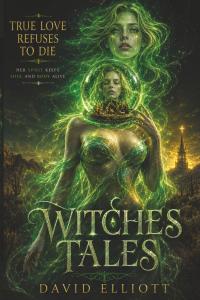
Religious divides rarely make for easy teenage romance, and that tension drives the new fantasy novel from David Elliott MA. Witches Tales places a young witch’s fight to save her coven against a love story that crosses into evangelical Christian territory, asking whether faith and magic can coexist in one relationship.
The book follows Sammy, a teenage witch starting high school in Odessa, Texas, while locked in conflict with her mother, an evil witch. Her everyday life becomes a collision course between paganism and evangelical Christianity, with questions about identity and belief surfacing before she even gets to class.
When Sammy falls for a Baptist minister’s son, her supernatural troubles gain a personal edge. The relationship forces her to navigate two communities whose worldviews seem fundamentally opposed, and the novel uses that friction to explore whether a person can be both Christian and witch, what common ground the two traditions might share, and whether love can bridge the gap.
Elliott sees two main audiences for this story: Christians trying to live faithfully in a largely pagan culture, and pagans who feel Christianity condemns anyone who falls short. His proposed middle ground is love, tolerance, and understanding. The novel presses the question further—not just whether these groups can coexist, but how each might avoid becoming the other’s persecutor.
There is more than teenage romance here. The book folds ancient philosophy and religious history into its fantasy frame, drawing parallels between today’s Neo-Paganism and the paganism of the Greco-Roman world. Readers interested in how belief shapes daily behavior will find references to ancient and early modern history woven through Sammy and JJ’s story.
The narrative’s deeper themes include free will, personal responsibility, and the goodness of the natural world. Elliott connects these ideas to his reading of St. John Chrysostom and Stoic psychology, particularly the care of the soul, and links that intellectual groundwork to his decades of work in mental health and substance abuse therapy.
Elliott credits Dostoevsky’s polyphonic novels as a model for letting competing perspectives speak for themselves. That approach keeps both pagan and Christian voices in the conversation, rather than letting either tradition be reduced to what its opponents say about it.
For fantasy readers who like their magic mixed with theology, the book tests belief systems through family conflict and first love.
“I transformed my text on Middle Platonism, TWO SOULS and a BODY: WHAT EVERY EDUCATED PERSON KNEW TO BE TRUE AND HOW THE EDUCATED CHRISTIAN DEVELOPED CHRISTIANITY IN HELLENISTIC TIMES, CREATING THE IDEAS OF FREE WILL AND MODERN PSYCHOLOGY, the philosophy at the time of Jesus and the early Church, into a modern fantasy to continue the discussion between Christianity and paganism.” — DAVID ELLIOTT MA
Elliott is a classical scholar and theologian who spent 40 years as a mental health and substance abuse counsellor. Raised by an evangelical grandmother, he also had a mother who practiced witchcraft. His earlier work includes Forever, a trilogy collected in one volume.
The book is available now.
Get your copy here:
https://www.amazon.com/dp/B0HHZJTFLQ
For review copies, interview requests, or additional information, please contact:
David Elliott
BrightKey PR
media@brightkeypr.com
Why it matters: In an era when religious and cultural divisions often dominate public conversation, Elliott’s novel offers a fictional space where opposing worldviews are forced into dialogue rather than dismissal. By grounding theological questions in a teenage romance, the book makes abstract debates about belief feel personal and urgent for readers of any age.