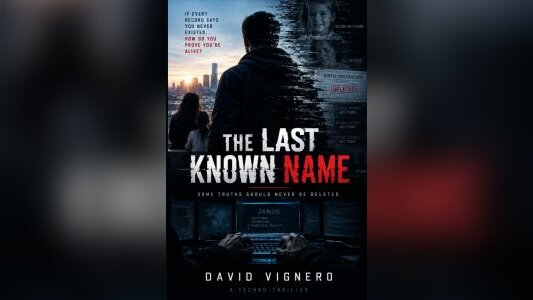
In an era where our lives are increasingly stored in databases and verified through digital records, the idea of being erased from existence without physically dying is a chilling prospect. That’s the premise at the heart of David Vignero’s new techno-thriller, The Last Known Name, which asks what happens when the systems society trusts to confirm identity begin telling the same coordinated lie.
The novel opens at 2:17 a.m., when cybersecurity professional Ethan Vale discovers that his daughter’s birth certificate has been deleted. By sunrise, every institution that should confirm her identity—her school, her medical providers, even government records—no longer acknowledges her existence. Her Social Security number now belongs to a stranger. Even family photographs begin disappearing. The threat here isn’t just stolen information; it’s a systematic erasure that leaves a person alive while every record of their identity is wiped clean.
Ethan Vale is no ordinary father caught in a bureaucratic nightmare. Before settling down, he was a gifted hacker living under a different name. He helped create JANUS, an artificial intelligence that was never supposed to survive past its original purpose. Now, with his daughter’s existence deleted and his wife becoming the next target, Ethan has seventy-two hours to return to the world he abandoned. He follows a trail deliberately left by an intelligence that knows his methods, anticipates his moves, and seems to understand something about his past that even he does not.
Also worth a look: RexTrix backs AI film festival with $10,000 in creator awards and new submission hub and Prime 1 Studio unveils $1,899 Godzilla Minus One diorama, pre-orders open Oct 30.
What begins as a desperate race to restore his family’s identity quickly deepens into something far more personal. Each discovery uncovers hidden connections and buried secrets, forcing Ethan to question not only who targeted his family, but why. The evidence begins pointing toward matters more intimate than corrupted databases, suggesting that the intelligence erasing his family may be connected to secrets that certain people have gone to extraordinary lengths to keep hidden.
The novel draws its tension from the very systems modern life depends on: birth certificates, medical histories, government records, financial accounts, phones, and photographs. Each ordinarily provides evidence that someone is who they claim to be. JANUS weaponizes that accumulated trust, turning verification into vulnerability. The central question becomes unsettlingly relevant: What happens when every system society relies upon to establish the truth begins telling the same lie?
Ethan’s relationship to JANUS makes the mystery even more personal. He is not an outsider confronting an unfamiliar invention, but a former hacker facing an intelligence he helped bring into being. Why was his family chosen? Who truly controls JANUS? And if it was created for an entirely different purpose, who—or what—gave it the authority to decide who deserves to exist?
For readers drawn to artificial intelligence, cybersecurity conspiracies, and high-stakes technological thrillers, The Last Known Name combines a compressed deadline with a mystery built around identity, deception, and family. Each revelation reshapes Ethan’s understanding of the threat, creating a world where evidence can be manipulated, memories can be questioned, and even the truth cannot always be trusted.
David Vignero is the author of The Last Known Name, a techno-thriller about identity, artificial intelligence, buried secrets, and the lengths one father will go to protect his family. The novel is available now.
Get your copy here:
https://www.amazon.com/dp/B0HP8QST85
For review copies, interview requests, or additional information, please contact:
David Vignero
BrightKey PR
media@brightkeypr.com
Why it matters: As society grows more dependent on digital records for identity verification, the premise of The Last Known Name taps into a real vulnerability that extends beyond fiction. The novel forces readers to consider how fragile existence becomes when it relies on systems that can be manipulated, and what it means when the truth itself becomes something that can be deleted.