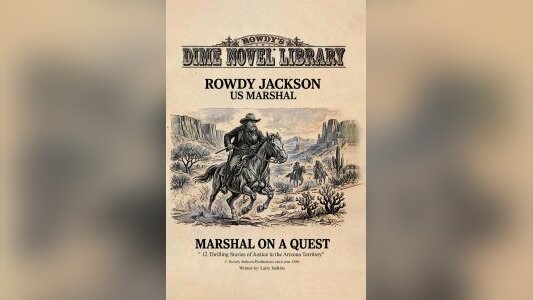
A man can pin on a badge, but he cannot erase the life that got him there. That tension drives Larry Judkins’s new collection of connected Western tales, Rowdy Jackson: US Marshal, which tracks a ranch-raised gunslinger as he stumbles toward a lawman’s duty while haunted by the violence that shaped him.
The story opens on a Texas ranch, where Rowdy Jackson learns a father’s lesson about keeping his word. That principle seems simple enough among livestock and open range. But Judkins’s collection follows Rowdy from that childhood into the company of outlaws, then toward law enforcement—where a man already marked by bloodshed must answer for a different kind of responsibility.
Rowdy grows up with little more than a horse, a rifle, and that single instruction from his father. Those sparse beginnings give the narrative a personal anchor before the scope widens. Keeping a promise means one thing on the ranch; carrying that same code into encounters with killers and gunfighters raises far harder questions about conduct and simple survival.
Also worth a look: Zareen Khan warns AI can’t replace human emotion as she reflects on call-center-to-Bollywood journey and Sandra Warren’s novel turns a dying father’s demand into a 50-year hunt.
Among outlaws, Rowdy learns what life looks like when the law is absent. His eventual movement toward a badge, then, involves more than a simple change in occupation. He approaches its responsibilities with intimate experience of the people and dangers that lie beyond its reach—and wearing that star does not erase the man he has been.
The tales move through the rough towns of West Texas and Arizona, into the saloons and streets of Tombstone. This geographic range places Rowdy’s personal decisions against a wider frontier landscape. His route brings encounters with legendary names of the Old West, alongside friendships and enmities that belong entirely to his own story.
Those relationships give loyalty a concrete place beside the gunfights and pursuit. Rowdy is not merely moving from one dangerous encounter to another: he is making friends and enemies while deciding what kind of man he wants to be. Loss adds another dimension to choices whose significance extends far beyond any immediate confrontation.
The connected-tale structure follows a central figure described in three roles: gunslinger, lawman, and wanderer. Read together, those roles frame a tension between the capacity for violence, the responsibility of enforcing law, and the uncertainty of belonging. None alone fully defines the man at the center of the collection.
The setting spans the 1860s through the 1880s, placing Rowdy’s changing circumstances against a changing American West. That breadth gives his story a horizon beyond any single town or gunfight. His search for a way home continues across the different places and responsibilities that mark his trail.
Home also gives the book a question that a badge cannot answer. Rowdy must consider whether there can be a place for him beyond frontier violence. The prospect remains uncertain: the search concerns not only a destination, but also the possibility of living differently from the life he has known.
His father’s early lesson provides a useful counterpoint to that uncertainty. The emphasis on keeping his word places a personal obligation beside the public duty associated with a lawman’s badge. Between those two measures of responsibility, the collection explores how loyalty and hard choices bear on Rowdy’s sense of himself.
Rowdy Jackson: US Marshal brings frontier action and a search for belonging into the same continuing story. Across its connected tales, Judkins follows a man whose passage toward law enforcement leaves his past intact and his future unresolved, with the question of home still reaching beyond the next pursuit.
Why it matters: In an era when stories often reduce Western lawmen to simple heroes or villains, Judkins’s collection offers a more complicated figure—a man carrying a father’s lesson into a world of bloodshed, where a badge provides authority but not absolution. The book suggests that the hardest frontier to cross may be the one inside a man himself.
For review copies, interview requests, or additional information, please contact:
Larry Judkins
BrightKey PR
media@brightkeypr.com