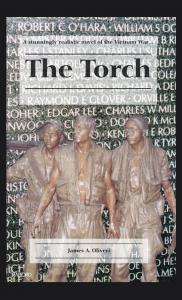
Most war stories end at the ceasefire line, but James A. Oliveri’s The Torch pushes past it — into the lonely, often hostile America that awaited Vietnam veterans who survived the fighting. The novel lands at a moment when military fiction is increasingly revisiting the war’s lesser-known early chapters, and Oliveri brings firsthand authority to that territory.
In The Torch, James A. Oliveri follows two young draftees whose arrival in Vietnam in the spring of 1964 places them in the path of an escalating war.
Jim Orletti and Lou Pizzatelli expect adventure, but their assignment to a U.S. Army advisory team in Hue brings them into a struggle they have not anticipated. Oliveri bases portions of the novel on his own military advisory service, giving the narrative a grounding that reaches beyond research alone.
The friends arrive as North Vietnamese Colonel Bui Xinh is preparing a major attack. Alongside fellow Americans Captain Ed Welch and Colonel Bill Carlin, they work to prevent Xinh and his loyal Sergeant Hahn from defeating the South Vietnamese Army. The opposing officers and the Americans serving in Hue place the advisory mission at the center of the action, with the two draftees experiencing the war as it intensifies around them.
Surviving Vietnam does not resolve the friends’ difficulties. Back in the United States, they encounter a society characterized by apathy and hostility toward them. One turns to crime and murder, while the other faces personal tragedy. Their shared wartime experience gives way to sharply different troubles in civilian life — a split that underscores how unevenly the war’s aftermath landed on those who served.
For Oliveri, the battle for Hue encapsulates the broader theme of the war in Southeast Asia. He also emphasizes the conduct of American military personnel, including draftees, whose service he regards as magnificent despite their relative obscurity. That perspective directs attention to men carrying out their duties without widespread recognition, rather than treating the advisory assignment merely as a backdrop to the friends’ story.
The novel’s early-1960s setting speaks to the audience Oliveri hopes to reach: readers with little or no knowledge of that period of the Vietnam War. Its combination of wartime action and troubled homecoming gives readers interested in military fiction a story that continues beyond the combat zone. The focus remains on two soldiers, connecting their experiences in Southeast Asia with the uncertain futures they face at home.
“There were very few novels about the early years of the Vietnam War.” — James A. Oliveri
James A. Oliveri is the author of The Torch. He served with a U.S. military advisory team and incorporated some of those personal experiences into the novel.
For more information about the book and its publisher, please visit Trafford Publishing at www.trafford.com.
Available now. Get your copy here:
https://www.amazon.com/dp/1412200571
For review copies, interview requests, or additional information, please contact:
James A. Oliveri
BrightKey PR
yeeditor27@yahoo.com
Why it matters: The Torch fills a gap in Vietnam War fiction by focusing on the pre-escalation advisory era and the overlooked soldiers who served in it. Its dual portrait of combat and troubled homecoming speaks to ongoing conversations about how veterans are received — or not — when they return. For readers of military fiction, Oliveri’s personal service adds an authenticity that broadens the genre’s scope beyond well-trodden late-war narratives.