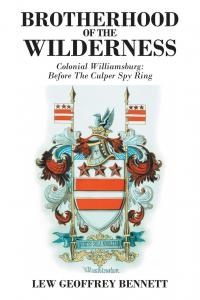
The founding of the United States is often told through battles and documents, but Lew Geoffrey Bennett’s Brotherhood of the Wilderness: Colonial Williamsburg: Before the Culper Spy Ring takes a different route—one that runs through forests, Indigenous alliances, and the quiet exchange of secrets. It’s a fresh angle on a familiar figure, showing how Washington’s path to the presidency was shaped long before the Revolution.
George Washington’s evolution is traced through wilderness survival, relationships with Indigenous peoples, and the careful sharing of sensitive intelligence in this historical novel. The narrative opens in 1789 with Seneca Chief Guyasuta watching Washington take the presidential oath in New York City, then flashes back to the colonial experiences that forged that moment. Scouts and a secretive brotherhood sit alongside military leaders and governors in this telling.
The setting returns to Augustine and Mary’s Ferry Farm along the Rappahannock River, where a young George tests plantation boundaries and draws the notice of his neighbors. Indigenous ceremonies become part of his early life, and Guyasuta—a spiritual leader tied to the Brotherhood—meets him at Logstown, bestowing the nickname Tall Hunter. Scout notebooks and journals supply the details of wilderness survival and battle intelligence that bind the two figures together.
As Britain and France clash, Washington transitions from surveyor to soldier. Governor Dinwiddie dispatches him with messages for the French Army in the Ohio Valley, and he later commands a Virginia Colonial Regiment during the French and Indian War. A discovered dead-drop involving Jacob Van Braam at Port Alexandria injects an espionage thread, while the story hints that wilderness spycraft foreshadowed the later Culper Ring’s methods.
The novel also examines a rigid social hierarchy that includes landed gentry, farmers, Indigenous people, and enslaved individuals. Washington’s personal connections push against those boundaries, with family encouragement, friendship, and the patience of a devoted wife receiving as much attention as battlefield exploits. For readers curious about colonial society, this approach offers a view that stretches past ranks and combat to the human bonds surrounding the central figure.
Trade routes and information networks round out the colonial world in the book. Indigenous connections span from Nova Scotia to the Spanish Colony of Florida, while fur traders link Canadian and American colonists and enslaved people. The emphasis on heritage, songs, travel paths, and weaponry keeps cultural knowledge at the forefront, so the wilderness is never just a backdrop for fighting.
Bennett aims his work at readers drawn to America’s journey toward freedom and the ideals that built the nation. He portrays the Brotherhood as people seeking liberation from oppressive monarchies and governments. That mission frames the novel’s take on independence: alongside Washington’s ascent, it invites readers to weigh the relationships, hands-on wisdom, and collective dedication embodied in the Brotherhood’s story.
“I decided to write the book when I became a member of the National
Society of the Sons of the American Revolution.”
— LEW GEOFFREY BENNETT
Bennett says the Brotherhood’s celebration of life for George Washington and his wife at Boone Mountain is the part of his novel that matters most to him.
Available now. Get your copy here:
https://www.amazon.com/dp/1977294545
For review copies, interview requests, or additional information, please contact:
Lew Geoffrey Bennett
BrightKey PR
media@brightkeypr.com
Why it matters: This novel reframes a founding father’s origin story around overlooked networks of Indigenous knowledge and covert communication, offering a reminder that American independence was built on alliances and intelligence as much as on military might. For modern readers, it underscores how cross-cultural cooperation and information sharing have long been engines of political change.