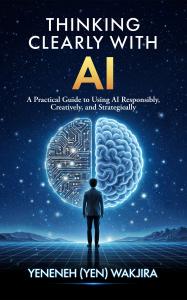
“Thinking Clearly With AI” moves beyond hype, providing a practical, human-first roadmap for building AI literacy and preventing automation bias.
As artificial intelligence continues to infiltrate nearly every corner of professional life, a quieter but more dangerous problem is emerging: people are trusting the machines too much. That is the central concern behind a newly released book from software engineer and information science scholar Yeneneh (Yen) Wakjira, who argues that the real risk isn’t AI’s capabilities—it’s our willingness to hand over critical thinking.
NEW YORK, NY, UNITED STATES, October 22, 2026 /EINPresswire.com/ — With AI tools now embedded in daily workflows across industries, the phenomenon known as “automation bias”—the tendency to overtrust machine-generated outputs—has become a pressing concern for organizations and individuals alike. Wakjira’s new publication, released through Spines, arrives as a timely counterweight to the hype cycle, offering professionals a grounded framework for deploying AI safely, creatively, and strategically while preserving human accountability at every step.
“Thinking Clearly With AI: A Practical Guide to Using AI Tools Responsibly, Creatively, and Strategically” cuts through the sensationalism that often surrounds discussions of artificial intelligence. Wakjira points to a fundamental misunderstanding at the heart of many AI mishaps: users frequently treat these systems as reasoning engines when they are, in reality, fluent text generators. The book leans on dual-process cognition theory to give readers the mental tools needed to separate AI’s polished language from the rigorous verification that real-world environments demand.
The book addresses the kinds of dilemmas professionals encounter daily—protecting brand reputation, steering through murky copyright and intellectual property terrain, and sidestepping the expensive consequences of unverified outputs. Wakjira brings these issues to life with case studies that range from a seemingly flawless AI-crafted email that wrecked a professional relationship to enterprise workflows that collapsed under pressure. He also prepares readers to approach future claims about Artificial General Intelligence (AGI) and machine consciousness with informed skepticism rather than reflexive acceptance.
Rather than chasing fleeting “prompt tricks” that lose relevance almost as quickly as they surface, Wakjira’s manuscript offers durable systems. Central to the approach is the “AI Literacy Ladder,” a structured path that moves users from basic drafting into advanced verification. Along the way, readers gain access to structured workflows, cognitive forcing functions, provenance logs for creative assets, and a 90-day readiness plan engineered to keep human judgment in the driver’s seat when stakes are highest.
The Highlights
• Dual-Process Cognition: Strategic mental models to prevent automation bias and ensure diligent human oversight.
• Responsible Workflows: Practical checklists and provenance logs tailored for high-stakes, public-facing AI content creation.
• AI Literacy Ladder: Concrete templates and exercises for transitioning from basic AI generation to advanced, secure verification.
Author Insight
“Artificial intelligence can be a powerful partner, but it should never replace human judgment, critical thinking, or responsibility,” says Wakjira. “With Thinking Clearly With AI, I want to help people move beyond simply using AI tools to understanding how to use them wisely. By building AI literacy, verifying information, and adopting responsible workflows, we can harness AI’s capabilities while keeping human judgment at the center of every important decision.”says Wakjira.
“Thinking Clearly With AI: A Practical Guide to Using AI Tools Responsibly, Creatively, and Strategically” is available now in print-on-demand and eBook formats.
About the Author
Yeneneh (Yen) Wakjira is a software engineer and graduate student in Information Science. Growing up watching his master electrician father solve complex problems, Wakjira developed a deep appreciation for practical, hands-on systems—a philosophy he now applies to the modern technological landscape to help others navigate the complexities of AI.
Book Details
• Title: Thinking Clearly With AI: A Practical Guide to Using AI Tools Responsibly, Creatively, and Strategically
• Author: Yeneneh (Yen) Wakjira
• Publisher: Spines
• ISBN: 9798906574862
• Availability: You can find this book on Amazon and major retailers worldwide.
Maria from Spines
Spines
hello@spines.com
Visit us on social media:
LinkedIn
Instagram
Facebook
YouTube
TikTok
Why it matters: As AI adoption accelerates across industries, the gap between tool usage and responsible oversight widens. Wakjira’s framework offers a practical countermeasure, positioning critical thinking and human accountability as non-negotiable components of any AI strategy—a lesson that will only grow more urgent as generative systems become more sophisticated.